Resilience Deck (like a Cyber Deck for emergencies)
Resilience Deck is an open-source, offline-first field computer designed to help communities diagnose, understand, and restore critical systems when normal infrastructure is unavailable.

Every year, communities face wildfires, floods, and natural disasters that cause billions in damage and claim hundreds of lives. The difference between a contained incident and a catastrophe often comes down to minutes — how quickly a threat is detected and how fast people are warned.
Today's disaster detection relies on centralized systems: CCTV feeds monitored by humans, weather alerts pushed through cellular networks, and cloud-based analytics. But during a disaster, the infrastructure we depend on for warnings is the first thing to fail. Cell towers go down, internet is severed, and the window for early intervention closes.
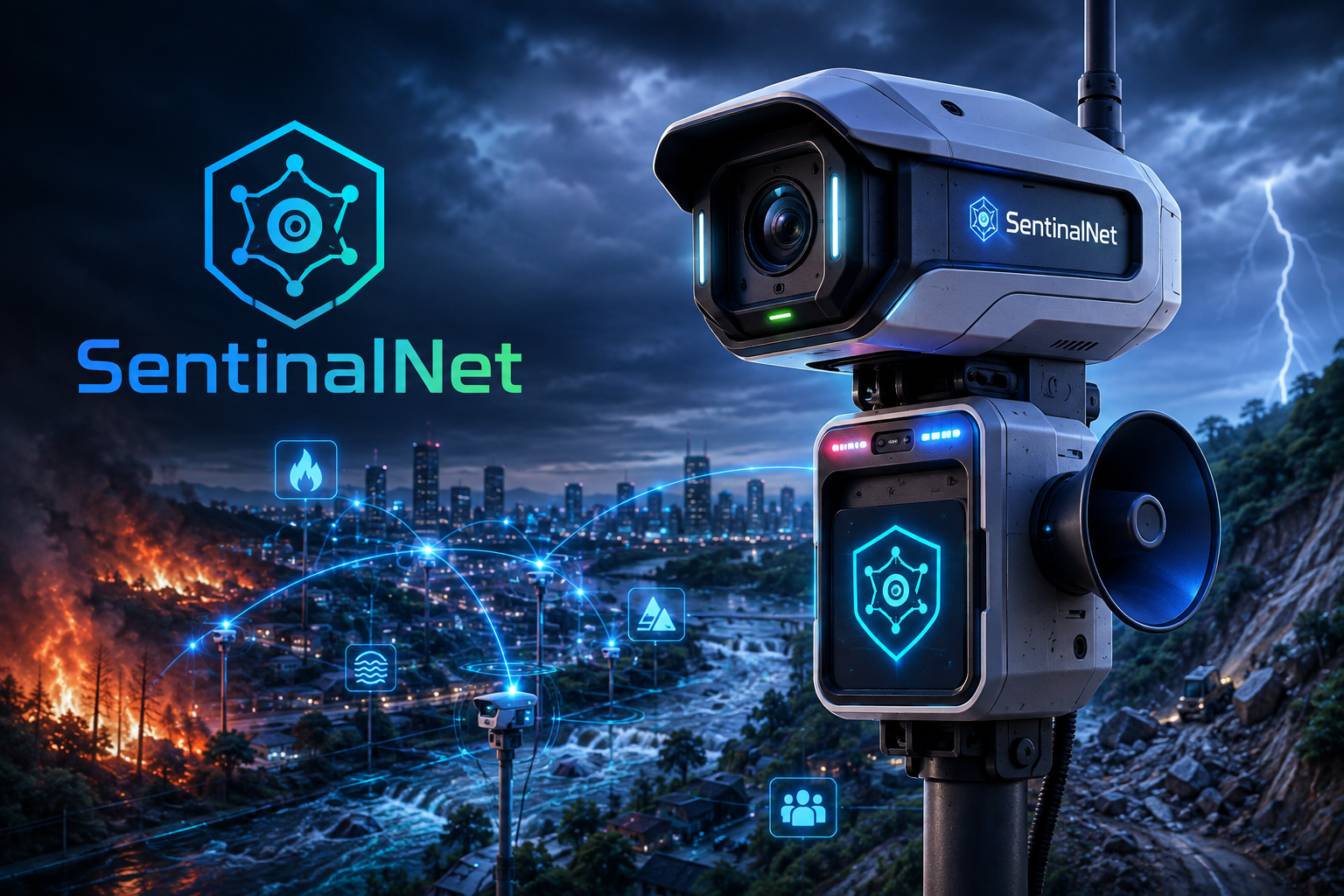
SentinelNet changes this. We're building autonomous, edge-AI-powered monitoring nodes ("SentinelNodes") that combine computer vision with environmental sensing to detect disasters, make local decisions, and activate immediate warnings — all running entirely on-device with zero cloud dependency.
Normal CCTV: Sees → Records SentinelNet: Sees → Understands → Decides → Warns → Guides Evacuation → Works Offline
Built on the Arduino UNO Q (Qualcomm Dragonwing QRB2210) with Edge Impulse models, each node is a self-contained intelligent sentinel that protects people even when everything else goes dark.
Hardware:
Arduino UNO Q (Qualcomm Dragonwing QRB2210 + STM32U585)
USB Webcam (any standard USB camera)
BME688 Environmental Sensor (temperature, humidity, gas, air quality)
WS2812B NeoPixel LED Strip (8 LEDs)
Piezo Buzzer + Small Speaker (8Ω)
SSD1306 OLED Display (128×64, I2C)
Breadboard and jumper wires
Software & Accounts:
Edge Impulse account (free)
Edge Impulse CLI (npm install -g edge-impulse-cli)
Python 3.x with pip
Git
Knowledge:
Basic Python programming
Familiarity with sensors and I2C communication
Basic understanding of machine learning concepts (helpful but not required — Edge Impulse handles the heavy lifting)
| Component | Qty | Notes |
|---|---|---|
| Arduino Uno Q | 1 | - |
| USB Webcam | 1 | - |
| Environment Sensor | 1 | - |
Edge Impulse makes on-device AI accessible. We train three models that work together to detect disasters with high confidence and low false positives.
Model 1: Fire/Smoke Detection (FOMO Object Detection)
Create a new project in Edge Impulse Studio
Upload fire and smoke image datasets with bounding box labels
Design impulse: Image (96×96 RGB) → FOMO Object Detection
Train the model targeting >85% accuracy
Deploy as a Linux (AARCH64) library for the Arduino UNO Q
Model 2: Flood Scene Classification (MobileNetV2)
Create a second project in Edge Impulse Studio
Upload scene images labeled: Normal, Minor Flooding, Severe Flooding
Design impulse: Image (96×96 RGB) → Transfer Learning (MobileNetV2)
Train and deploy alongside the fire model
Model 3: Environmental Anomaly Detection
Create a third project for time-series sensor data
Collect baseline readings from the BME688 (temperature, humidity, gas resistance)
Design impulse: Raw Data → Anomaly Detection (K-means)
This model detects rapid temperature rises, abnormal gas levels, and humidity spikes
The key innovation is multi-modal sensor fusion — the system doesn't act on a single signal. When the camera detects potential fire, the system checks: is the temperature sensor showing a rapid rise? Is the gas sensor detecting combustion byproducts? Only when multiple signals agree does it escalate.
Tiered Alert Levels:
Level 0: NORMAL — Green LEDs, routine monitoring
Level 1: SUSPICION — Single modality detects anomaly
Level 2: WARNING — Yellow LEDs, camera + sensor agreement
Level 3: DANGER — Red LEDs, high-confidence multi-modal confirmation
Level 4: EMERGENCY — Buzzer/speaker active, display shows evacuation guidance
The decision engine runs as a Python application on the QRB2210's Debian Linux side. It fuses camera inference results with sensor data received from the STM32 MCU via serial communication, applies confidence thresholds, and triggers the appropriate alert level.
The system also includes de-escalation logic — if threat indicators subside, alerts automatically downgrade.
The Arduino UNO Q's dual-brain architecture is perfect for this:
MPU side (QRB2210 — Debian Linux): Runs the camera, AI models, and decision engine. MCU side (STM32U585 — Zephyr OS): Reads sensors and controls alert hardware with real-time precision.
Sensor Connections (MCU via I2C):
BME688 → I2C bus (SDA/SCL)
SSD1306 OLED Display → I2C bus (SDA/SCL)
Alert Hardware (MCU via GPIO):
WS2812B LED Strip → Digital pin (NeoPixel protocol)
Piezo Buzzer → Digital pin (PWM)
Speaker → Digital pin (audio output)
MCU ↔ MPU Communication:
Serial/UART bridge
MPU sends alert commands → MCU actuates hardware
MCU sends sensor readings → MPU feeds into fusion logic
Fire Detection Test:
Present controlled fire/flame imagery (video on a screen or safe controlled flame) to the camera
Simultaneously, use a heat source near the temperature sensor
Expected: System escalates from NORMAL → SUSPICION → WARNING → DANGER as both camera and sensor confirm the threat
LEDs should transition Green → Yellow → Red, buzzer activates, OLED shows "FIRE DETECTED"
Flood Detection Test:
Show flood scene images/video to the camera
Expected: System classifies the scene severity and escalates accordingly
OLED displays flood stage and evacuation guidance
Offline Operation Test:
Disconnect WiFi / unplug network cable entirely
Repeat the fire detection test
Expected: System operates identically — all inference is local, no cloud dependency
This is the most important demo: proving the system works when infrastructure fails
False Positive Test:
Present ambiguous scenes (sunset, steam, fog, heavy rain) to the camera
Expected: Camera may trigger SUSPICION, but without sensor corroboration, system does NOT escalate to DANGER
This demonstrates the value of multi-modal sensor fusion
SentinelNet demonstrates that a single intelligent node can detect disasters and warn people faster than any centralized system — and keep working when everything else goes dark.
Future directions we're excited about:
Multi-node mesh networking via LoRa — nodes share threat alerts across zones without internet, creating a resilient area-wide warning network
Federated learning — each node learns from its local environment and shares only model updates (not video) with the network, continuously improving detection while preserving privacy
Voice-based evacuation guidance — pre-recorded or TTS-generated voice instructions through the speaker, tailored to the specific threat and location
Solar-powered deployment — making nodes fully energy-independent for remote wildfire zones and infrastructure corridors
The vision: a network of SentinelNodes protecting schools, transit hubs, forests, dams, and communities — autonomous intelligence that lives where the risk lives.
We're building SentinelNet in the open and would love your input, ideas, and feedback.
Qualcomm Developers Discord: https://discord.gg/UzPyHGvCMt
Edge AI Foundation Discord: https://discord.com/invite/53RhJRsED9
Whether you're a developer, a first responder with domain knowledge, or someone who's lived through a disaster — your perspective makes this better. Drop us an issue on GitHub or say hi on Discord.
Let's build something that actually keeps people safe. 🛡️