A solar-powered camera and thermal node that detects wildfire smoke and ignitions entirely on an Arduino UNO Q, using integer-only SuperFloat CNNs. It alerts over whatever link survives, and no image ever leaves the board.
Wildfire Sentinel is a solar-powered camera and thermal node that detects wildfire smoke and ignitions entirely on an Arduino UNO Q. It runs on SuperFloat, an exponent-free number format that makes CNN inference integer-only. It sounds a local alarm with no network at all, queues alerts until any link comes back, and never sends an image anywhere.
Track A (Developers). Challenge areas: 1 Anticipate and Mitigate Risk, 3 Enable Real-Time Response, 5 Operate in Mission-Critical Environments.
camera ->5x3 tiles ->SmokeNet (SF8, 4x Cortex-A53, NEON) -> temporal voter -> alert queue -> webhook
|
MLX90640 ->EmberNet (SF8, Cortex-M33) -> buzzer + LED matrix <----+ watchdog keeps the MCU tier
alive if Linux goes down
Tier
Runs on
Model
Detects
Camera
QRB2210, 4x Cortex-A53
SmokeNet: 28 M MACs/tile, 269 KiB
smoke plumes at distance, by day
Thermal
STM32U585, Cortex-M33
EmberNet: 0.66 M MACs, 15 KiB
ignition heat, day and night
1. What problem are you solving, and which community is affected?
Wildfires are cheapest to stop in their first minutes and most destructive once
they run. The Camp Fire (2018), Lahaina (2023) and the Los Angeles fires of
January 2025 are recent reminders: in each, time to detection and time to
warning shaped the losses.
The places where ignitions start are where detection is weakest:
often reliant on someone noticing smoke and calling it in.
Camera networks exist, but the mature ones stream video to cloud AI. That needs:
continuous high-bandwidth backhaul;
per-camera subscriptions that small counties, fire districts and tribes
struggle to fund;
links that stay up. A fire damages power and communications first, so the
systems are weakest when they matter most.
The affected community is rural and wildland–urban interface residents in
fire-prone regions of the US, and the small, often volunteer, fire services that
protect them.
2. Who benefits?
Volunteer and county fire departments, and tribal fire programs. They get
minutes-scale alerts with a bearing (the tile index maps to a direction) for
the price of a node, not a subscription.
Residents of WUI communities, ranches and remote homes. A local buzzer
and LED alarm work even when the network does not, and webhook alerts can feed
existing community alerting.
Utilities and operators of remote infrastructure (substations, pumping
stations, telecom sites). They can watch their own assets and corridors
without streaming video off site.
Land managers and researchers. The models, firmware and data pipeline are
open source and adaptable to other hazards, such as smoke from industrial
sites or post-fire hotspot monitoring.
3. Technical approach: hardware and edge AI model
Hardware.
Arduino UNO Q: Qualcomm Dragonwing QRB2210 with 4x Cortex-A53 on Debian, plus
an STM32U585 Cortex-M33.
A USB camera.
An MLX90640 32x24 thermal array on Qwiic.
A buzzer, a mute button and the on-board LED matrix.
A 60 W solar panel with a 320 Wh LiFePO4 battery, about 3 days of autonomy.
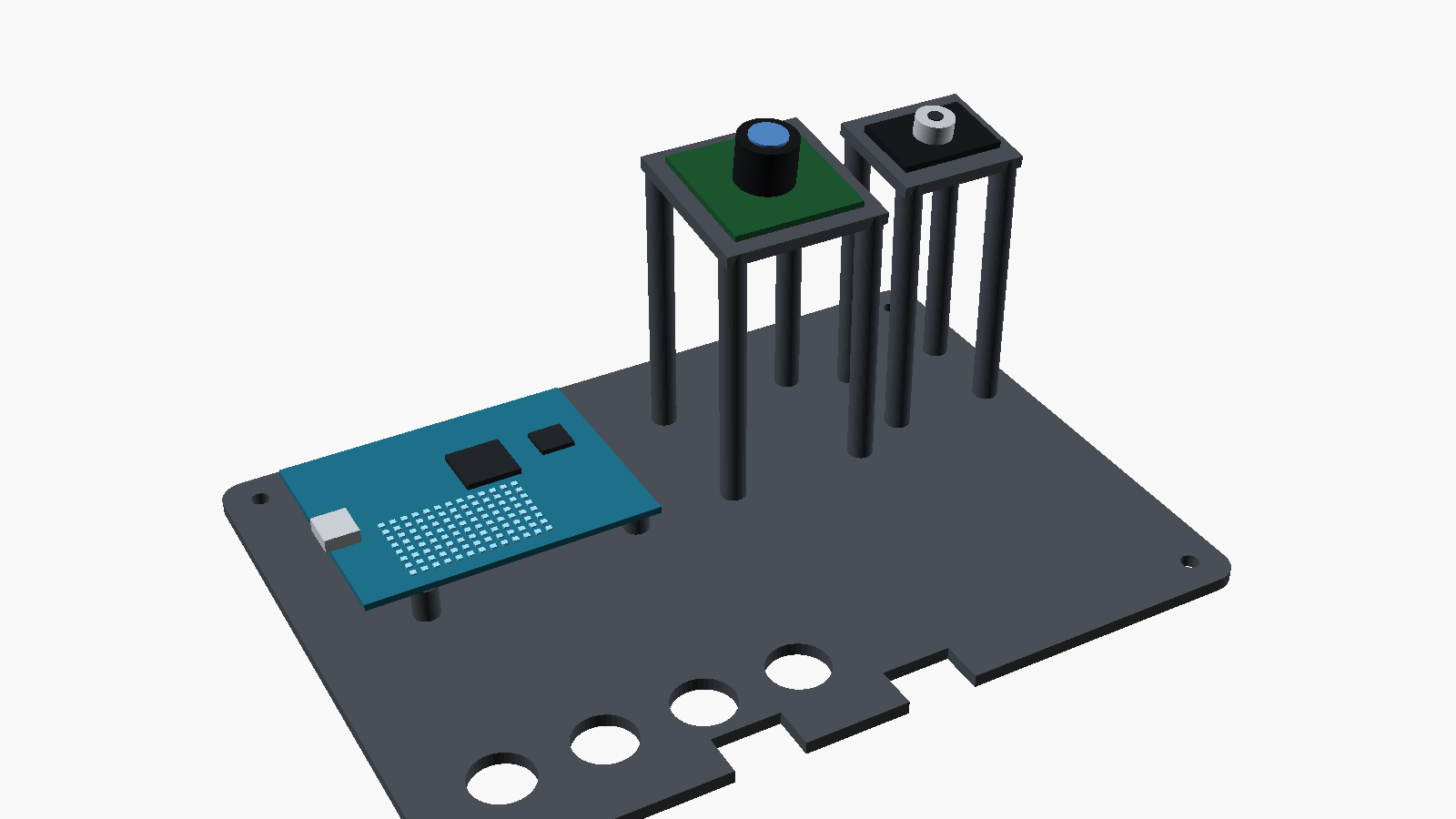
A 3D-printed mount in an IP65 box.
All hardware design files are in the repository.
Two tiers on one runtime.
Camera tier (QRB2210). Each frame is resized and cut into 15 tiles of
128 px, following the tiled approach of SmokeyNet (Dewangan et al., 2022).
Each tile is classified clear, smoke or flame by SmokeNet: 28 M MACs and
269 KiB of weights.
Four threads run on the four A53 cores.
A temporal voter requires 4 of 6 frames for smoke and 2 of 3 for flame, which
suppresses glare, cloud and dust.
Thermal tier (STM32U585).EmberNet (0.66 M MACs, 15 KiB) classifies
MLX90640 frames together with their frame-to-frame difference, so flicker
counts as evidence.
It runs on the MCU, independently of Linux.
It keeps watching day and night, even if Linux hangs; a heartbeat watchdog
shows the fault on the matrix.
The edge AI method: SuperFloat.
SuperFloat (my prior work,
aloshdenny/superfloat) drops the
exponent entirely: a value is a sign plus fraction bits, i.e. Q1.(x−1) fixed
point. Trained network weights almost never leave [−1, 1], and my benchmarks
show SF8 weights matching FP32 on EuroSAT remote-sensing classification.
Because every SuperFloat scale is a power of two, a whole CNN runs on integers:
int8 multiplies and int32 accumulation;
one rounding shift and a clamp per layer;
no zero points, no per-channel float scales, no requantisation multipliers.
SF4 weights (2 per byte) are a subset of SF8 and use the same kernel.
The quantisation-aware training is constructed so that the PyTorch forward pass
is bit-for-bit identical to the C runtime on the board. This is checked by the
test suite, so the accuracy measured in training is the accuracy deployed.
Edge Impulse.
Dataset management: tiles from D-Fire and HPWREN, then our own field
captures, are uploaded and labelled in Edge Impulse.
Baseline comparison: each trained model is exported as an ONNX float twin
for Edge Impulse BYOM. Edge Impulse profiles it and builds an int8 .eim for
the UNO Q (runner-linux-aarch64).
SuperFloat and Edge Impulse int8 are then compared on the same board and
the same tiles, for accuracy, latency and power.
Integration: the app runs in Arduino App Lab, using the Bridge, Camera and
WebUI bricks.
4. Why must it run at the edge?
Connectivity fails first.
Many ignition-prone areas have little or no coverage.
Fires damage the power and communications infrastructure cloud systems
depend on.
An edge node decides locally. It sounds a local alarm with no network, and
queues alerts to disk until any link returns.
Bandwidth and cost.
Streaming 720p around the clock is gigabytes per camera per day, which is
prohibitive over cellular or satellite and on solar power.
An alert is about 200 bytes. Moving the decision to the board cuts backhaul
by roughly six orders of magnitude.
Latency. The system catches smoke within seconds of a frame, without
queueing behind a cloud pipeline.
Privacy.
Frames never leave the board and are never stored.
The model has no person class.
Alerts carry a tile index and a score, not an image.
This keeps the project clear of surveillance concerns and makes community
consent much easier.
Power. Integer-only inference on the A53 and the M33 fits a solar budget.
The MCU tier keeps watching even when the Linux side is throttled.
5. How will you share the journey?
Open source from day one: the code, the trained models, the hardware files
and the test suite are public under MIT, with commit history showing how it was
built.
devEco project page: weekly updates through stage 2, with on-board
measurements (latency, power, accuracy) as soon as the kit arrives, including
the ones that disappoint.
Edge Impulse public project: the labelled field dataset and the int8
baseline, so others can reproduce the comparison.
Write-ups:
an adaptation guide (other hazards, other cameras, other boards);
a technical article on integer-only SuperFloat inference;
a demo video of the node detecting smoke on recorded HPWREN sequences and
a controlled burn-barrel test.
Negative results get published too. The SuperFloat benchmark repository
already documents where the format fails, such as transformer activations. This
project will do the same.
6. Honest feasibility assessment
Already working (before the kit arrives):
The SuperFloat integer runtime: C99, no allocator, NEON on aarch64.
It is bit-exact against a reference implementation and against the training
forward pass.
It is tested on macOS arm64 and Linux aarch64, with about 120 automated
tests.
The QAT pipeline and exporter, the SmokeNet and EmberNet definitions, the full
App Lab application, and the MCU sketch.
The sketch is compiled and exercised on a host against stub Arduino APIs.
Those host tests cover the watchdog, alarms, mute and a thermal hotspot
detected by EmberNet.
Edge Impulse tooling, the BOM, wiring, the power budget and the printable
mount.
Not yet proven, and the plan for each:
A53 speed.
Projected at 15–30 ms per tile and about 0.1 s per 15-tile frame on four
cores. A frame every 2 s leaves a 10–20x margin.
Fallbacks: a narrower SmokeNet or fewer tiles.
First measurement in week one with the kit.
Accuracy on real smoke.
Neither model has been trained on real imagery yet. The thermal model is a
bootstrap trained on synthetic frames.
SmokeNet training on D-Fire is a stage 2 week-one task.
Success means meeting or beating the Edge Impulse int8 baseline on the same
tiles.
False alarms. These are the reason fire agencies distrust automated
detection. The temporal voter will be tuned on real HPWREN sequences, and false
alarms per camera-day will be reported alongside time to detect.
Library and toolchain unknowns on the UNO Q Zephyr core, such as the
MLX90640 driver. Fallback: port the Melexis reference C driver.
Night. RGB smoke detection does not work in darkness. The thermal tier
covers ignitions at night, and that limitation is stated plainly.
Scope and support. I am a solo developer, and the scope is sized for one
person over seven weeks: everything except on-board measurement and field data is
built. The main risks are performance and data, not missing software.
The deliverable for December 2 is:
one working outdoor node;
measured accuracy, latency and power against the Edge Impulse baseline;