
project
Wildfire Sentinel
A solar-powered camera and thermal node that detects wildfire smoke and ignitions entirely on an Arduino UNO Q, using integer-only SuperFloat CNNs. It alerts over whatever link survives, and no image ever leaves the board.
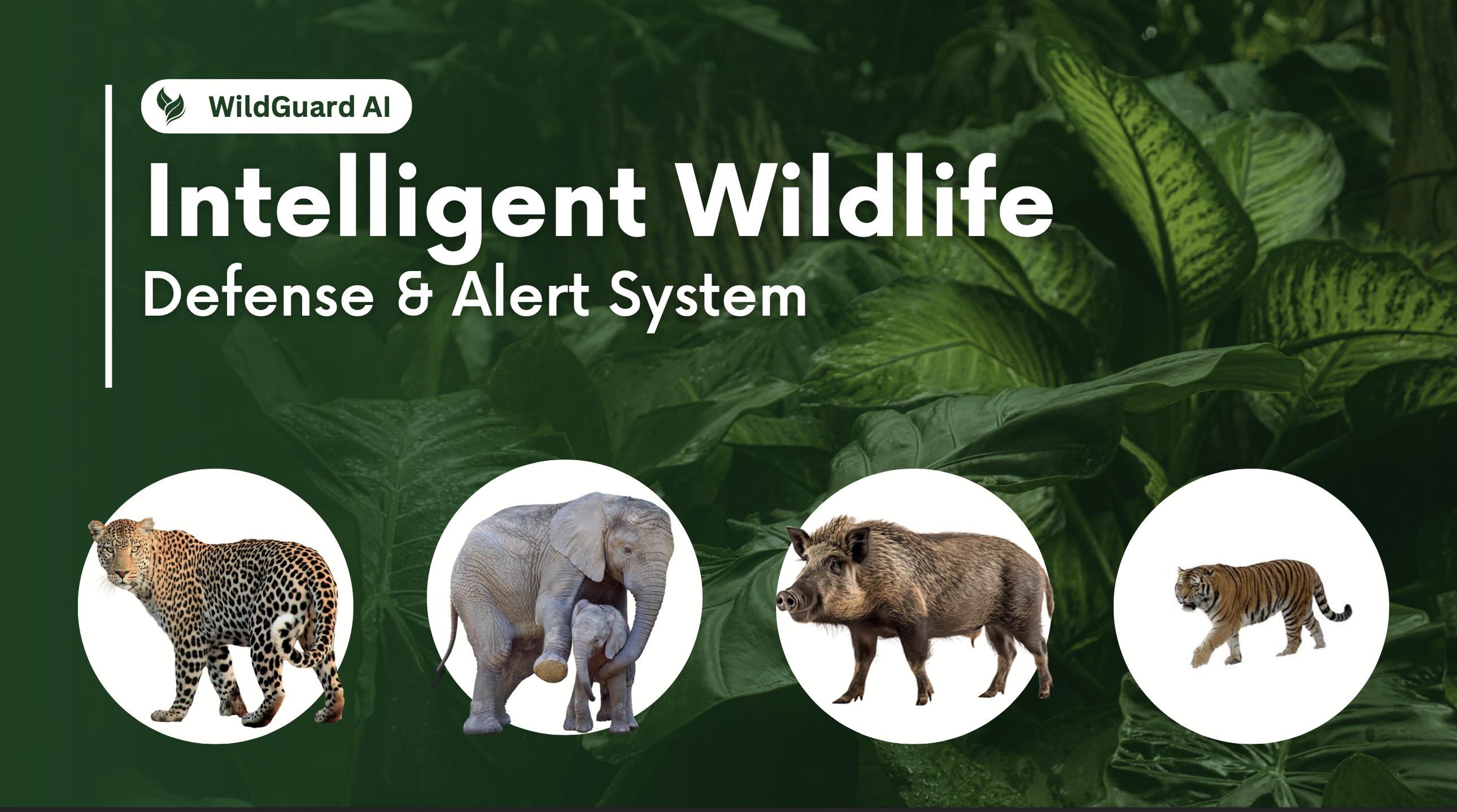
WildGuard is a solar-powered, AI-driven robotics system that continuously monitors forest roads to detect wildlife, deploy escalating deterrents, and issue real-time alerts to prevent human-animal conflicts
The Problem:
Lack of Real-Time Awareness: Most forest-side roads lack systems to detect wildlife in real time, making it difficult to prevent sudden, dangerous encounters.
Inadequate Infrastructure: Traditional static warning signs and fences cannot adapt to dynamic changes in animal movement, migration, or behavior.
Delayed Response and Limited Visibility: Forest departments lack automated systems, forcing rangers to rely on chance sightings or delayed reports, which slows down response times.
Absence of Predictive Tools: There are currently no systems that learn from wildlife patterns to forecast risks or predict danger zones before conflicts happen.
The Community it Affects:
Travelers and Commuters: Face a high risk of surprise animal incursions and collisions while navigating remote forest roads
Nearby Villages and Communities: Suffer from panic, injuries, and accidents due to unexpected wildlife incursions near forest boundaries.
Forest Departments and Rangers: Struggle to efficiently manage human-wildlife conflicts due to a lack of predictive tools and real-time data on when, where, and how attacks occur.
Travelers and Commuters: They benefit from real-time warnings and improved safety, which reduces the risk of surprise animal attacks and vehicle collisions on forest-adjacent roads.
Nearby Villages and Communities: Real-time alerts protect local residents from unexpected wildlife incursions, helping to prevent panic, accidents, and injuries.
Forest Departments and Rangers: Officials benefit from automated, real-time alerts and accurate location data, enabling much faster deployment of rescue or control teams. They also receive daily wildlife activity reports and predictive data to help forecast high-risk zones and plan long-term strategies.
Wildlife: The animals themselves benefit from the system's early detection and robotic deterrents, which gently guide them away from danger zones and prevent fatal encounters, ultimately saving animal lives.
Local Governments and Conservation Organizations: These groups benefit from the system's data-driven insights and scalable model, which promotes peaceful coexistence and aids in regional conservation efforts.
Technical Approach & Architecture
Core Processing & Edge AI: An Arduino Uno replaces cloud-dependent compute modules to run lightweight machine learning models locally. Platforms like Edge Impulse are used to train behavioral models, which are exported as C++ libraries to run directly on the microcontroller for rapid, offline decision-making without internet dependency.
Sensory Input: The Uno interfaces with motion and thermal sensors to detect animal heat signatures and movement, ensuring continuous monitoring at night or in dense fog.
Robotic Deterrent & Sound Systems: Upon detecting an animal in a critical zone, the Uno triggers automated deterrents to gently guide it away from the road. A dedicated sound system is central to this response, utilizing a compact PAM8403 amplifier to drive high-decibel audio warnings through external speakers. This audio setup, paired with automated flashing lights, is integrated into a custom printed circuit board designed in EasyEDA for robust field operation.
IoT Communication: The Uno uses low-power IoT modules (such as LoRa, GSM, or Wi-Fi) to transmit real-time location data and alerts to forest officials, nearby villages, and roadside digital signboards.
Power Management: The remote hardware node runs entirely on a solar power system with battery backup, ensuring the setup operates continuously in remote environments with minimal human maintenance.
Zero Internet Dependency: Remote forest roads and wildlife hotspots typically lack reliable cellular or broadband connectivity. Processing data locally on the edge ensures the system remains fully operational and can make critical decisions without needing an active internet connection.
Instantaneous Decision-Making: Human-wildlife encounters happen suddenly and escalate in seconds. Edge AI allows the microcontroller to analyze sensor data and instantly trigger the PAM8403-driven sound system and light deterrents without the latency of round-trip cloud communication.
Power Efficiency for Solar Operation: Constantly streaming raw thermal or motion data to a cloud server consumes massive amounts of energy. Edge AI processes the heavy data on-device, meaning only tiny, lightweight alert packets need to be transmitted via low-power IoT modules (like LoRa or GSM), which allows the entire system to run reliably 24/7 on a standalone solar power setup.
Mission-Critical Reliability: By removing reliance on external cloud servers, the localized hardware architecture ensures a highly resilient, autonomous system that continues to protect both travelers and wildlife even if regional communication infrastructures fail.
Hardware & PCB: Custom EasyEDA layouts integrating the PAM8403 audio amplifier for robotic deterrent systems are highly viable.
Prototyping: Designing and 3D printing weather-proof sensor enclosures using Fusion 360 and a Bambu Lab A1 Mini is immediately actionable.
Firmware: C++ control logic is well-supported for polling sensors and triggering zero-latency audio and visual warnings.
Edge AI Limits: The Arduino Uno's memory (2KB SRAM/32KB flash) is the primary hurdle; on-device machine learning models will require aggressive quantization or a pivot to a larger microcontroller.
Power Budget: Maintaining 24/7 solar operation while powering high-decibel audio requires strict deep-sleep firmware management.
| Component | Qty | Notes |
|---|---|---|
| arduino uno q | 1 | - |
| web cam | 1 | - |
| gsm module | 1 | - |
| Microphone Module | 1 | - |
| Motion Sensors | 1 | - |
| Solar Panel | 1 | - |
| Battery Pack | 1 | - |
| PAM8403 Audio Amplifier module | 1 | - |
| High-intensity LED modules or automated lights | 1 | - |
| PETG or ASA filament for weather-proof 3D-printed housings | 1 | - |
| external speakers | 1 | - |
Start by using a standard solderless breadboard and jumper wires to connect your Arduino Uno to the PAM8403 audio amplifier, sensor headers, and IoT modules. Use the HLK-PM series step-down converters to ensure stable voltage regulation, routing power and ground rails clearly on the breadboard. Verification: Power the Arduino Uno via USB and check that the power indicator LEDs on your connected sensor and amplifier modules light up.
Wire up the PIR motion sensors, thermal cameras, and microphone modules on the breadboard to gather baseline environmental data. Capture various states of movement and ambient noise, then upload these datasets to Edge Impulse to train your lightweight machine learning model. Verification: Log into your Edge Impulse dashboard and verify that the uploaded audio and motion data samples appear correctly in the Data Acquisition tab.
Export the trained model from Edge Impulse as a highly optimized C++ library. Because the Arduino Uno is strictly limited to 2KB of SRAM and 32KB of flash memory, aggressively quantize the model to fit. Flash the C++ firmware to the microcontroller so it can process sensor data locally. Verification: Open the Serial Monitor in the Arduino IDE (set to the correct baud rate) and look for the successful initialization message from your AI model to confirm it loaded without memory crashes.
Write the interrupt-driven C++ control logic to trigger immediate responses upon a positive AI detection. Program the Uno to drive the PAM8403 amplifier, outputting high-decibel audio warnings through external speakers, and sync this with automated high-intensity LED flashes. Verification: Trigger a manual "test detection" through your code and confirm the external speakers play the warning sound loudly while the LEDs flash simultaneously.
Connect your low-power IoT module (LoRa or GSM) using the breadboard. Format lightweight data payloads in the firmware to transmit real-time location alerts, daily logs, and risk forecasts to forest rangers and nearby digital signboards. Verification: Send a test ping from the Arduino Uno and confirm the alert packet is successfully received on your target dashboard or mobile phone.
Because jumper wires easily pull loose in the field, transfer your working breadboard layout to a standard perfboard (protoboard). Solder the components and wire connections permanently to create a vibration-resistant, solid unit without needing a custom-manufactured PCB. Verification: Before powering the system on, use a digital multimeter in continuity mode (the "beep" setting) to probe the power and ground lines and ensure there are no short circuits.
Draft a custom, weather-proof chassis using Fusion 360 or FreeCAD, including internal standoffs for your soldered perfboard. Print the components, embed M3 brass heat-set inserts, and secure the perfboard, sensors, and IoT modules into the chassis using M3 stainless steel screws. Verification: Gently shake the assembled enclosure to ensure the perfboard and sensors are mounted tightly and do not rattle against the plastic housing.
Wire the main power input to a solar charge controller, connecting a dedicated solar panel and a battery backup pack to guarantee 24/7 autonomous operation. Mount the completed WildGuard node securely along a targeted forest road boundary and initiate live field testing.
Verification: Check the LED indicators on your solar charge controller during daylight to confirm the battery is actively receiving a charge from the solar panel.
A solar-powered camera and thermal node that detects wildfire smoke and ignitions entirely on an Arduino UNO Q, using integer-only SuperFloat CNNs. It alerts over whatever link survives, and no image ever leaves the board.

BRASA is an open-source, low-cost node that watches a home after its residents evacuate, uses on-device AI to detect a growing ember ignition, sprays only the affected zone, verifies the result thermally, and reports to responders over an encrypted offline LoRa mesh.