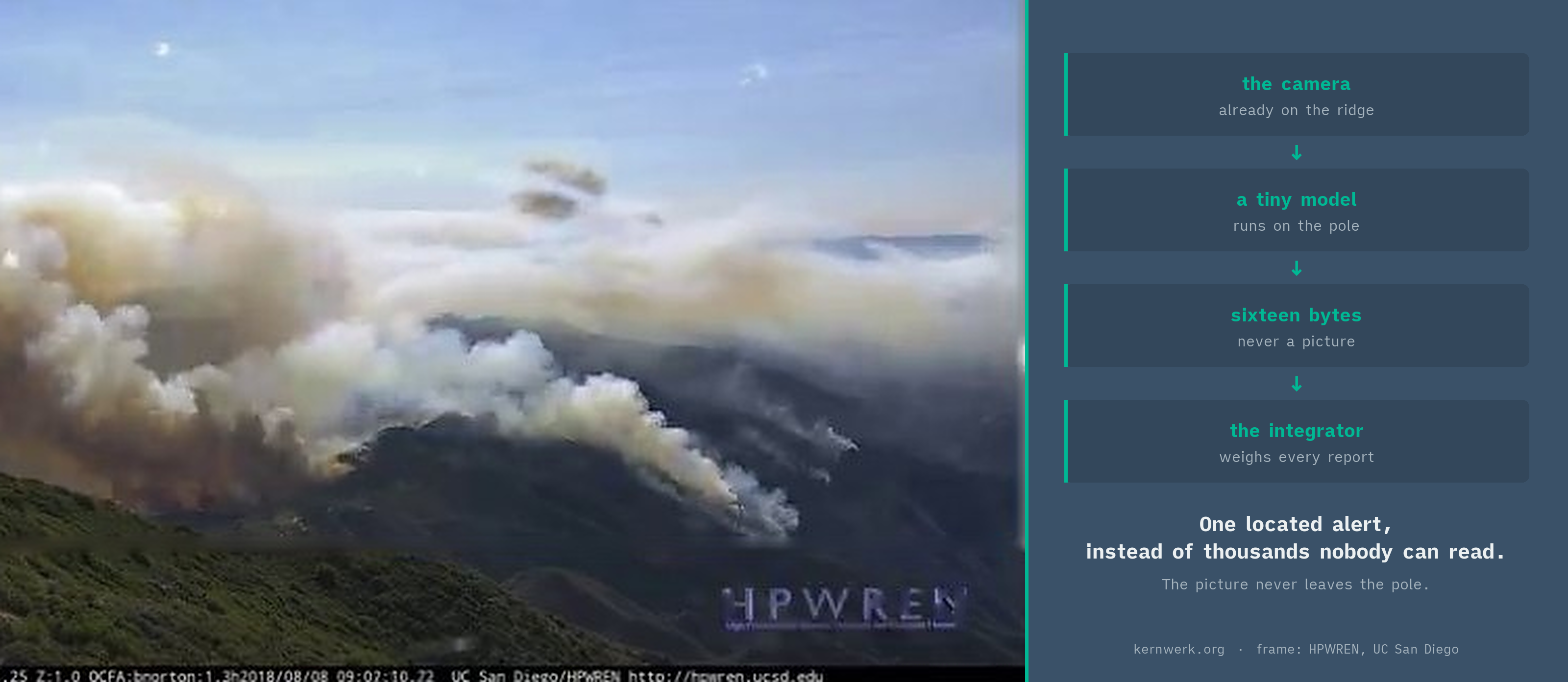
Thousands of cameras already watch the ridgelines of the western states. The pictures exist. Nobody can afford to look at them.
That matters because of which fires do the damage. About one in ten fires escapes the first response, and those few burn 85% of all the land lost. Everything depends on the first minutes, and the first minutes are exactly when a fire looks like almost nothing.
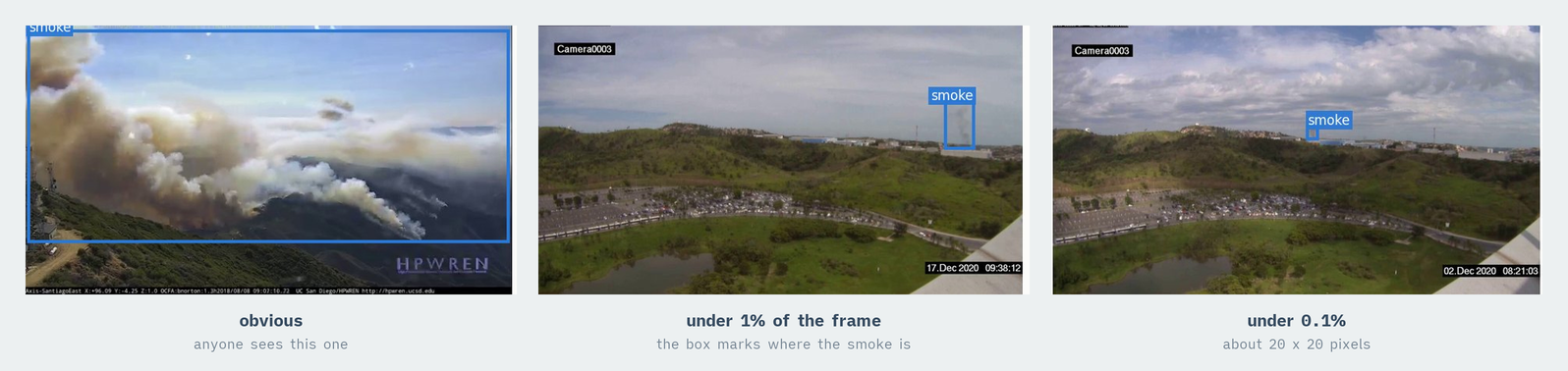
Here is the same problem in three real frames. The first one anybody would catch. In the other two the smoke is a smudge a few pixels wide, and there are thousands of cameras producing frames like this, all day, mostly with nothing in them at all.
The usual answer is to send every picture to a data centre and let a big model look. That does not work here. These cameras sit on ridges at the end of thin radio links with no bandwidth for video, and nobody is going to stream footage of their own property to a fire service. So the pictures stay where they are, and the problem stays unsolved.
What we are building
Two halves.
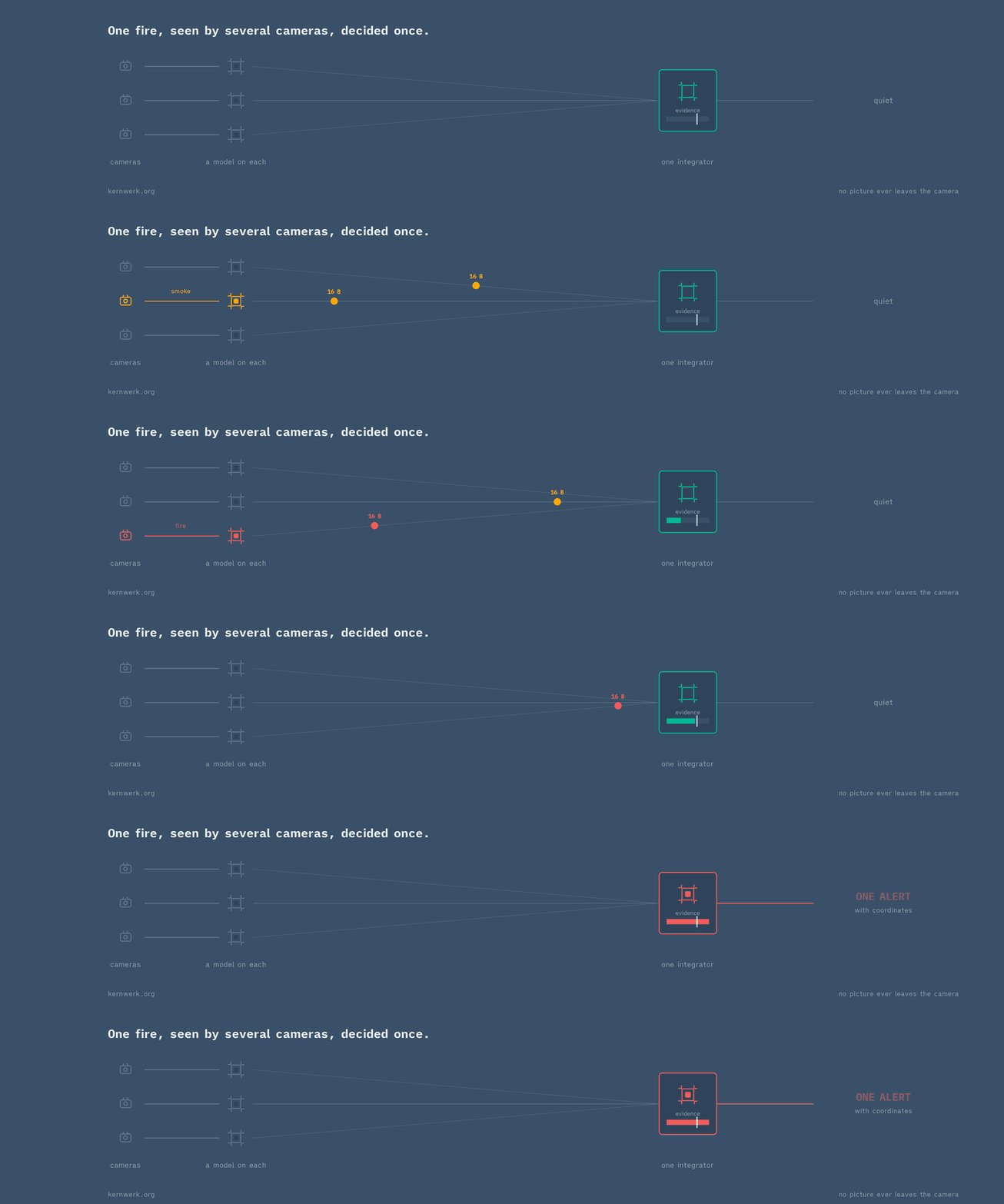
A detector that runs on the camera itself. It looks at each frame where the frame already is, and decides one thing: is there smoke or fire here. It is small enough to run on a $30 chip with no GPU and no operating system, which means it fits on almost anything already mounted on a pole. The picture is read and thrown away on the spot.
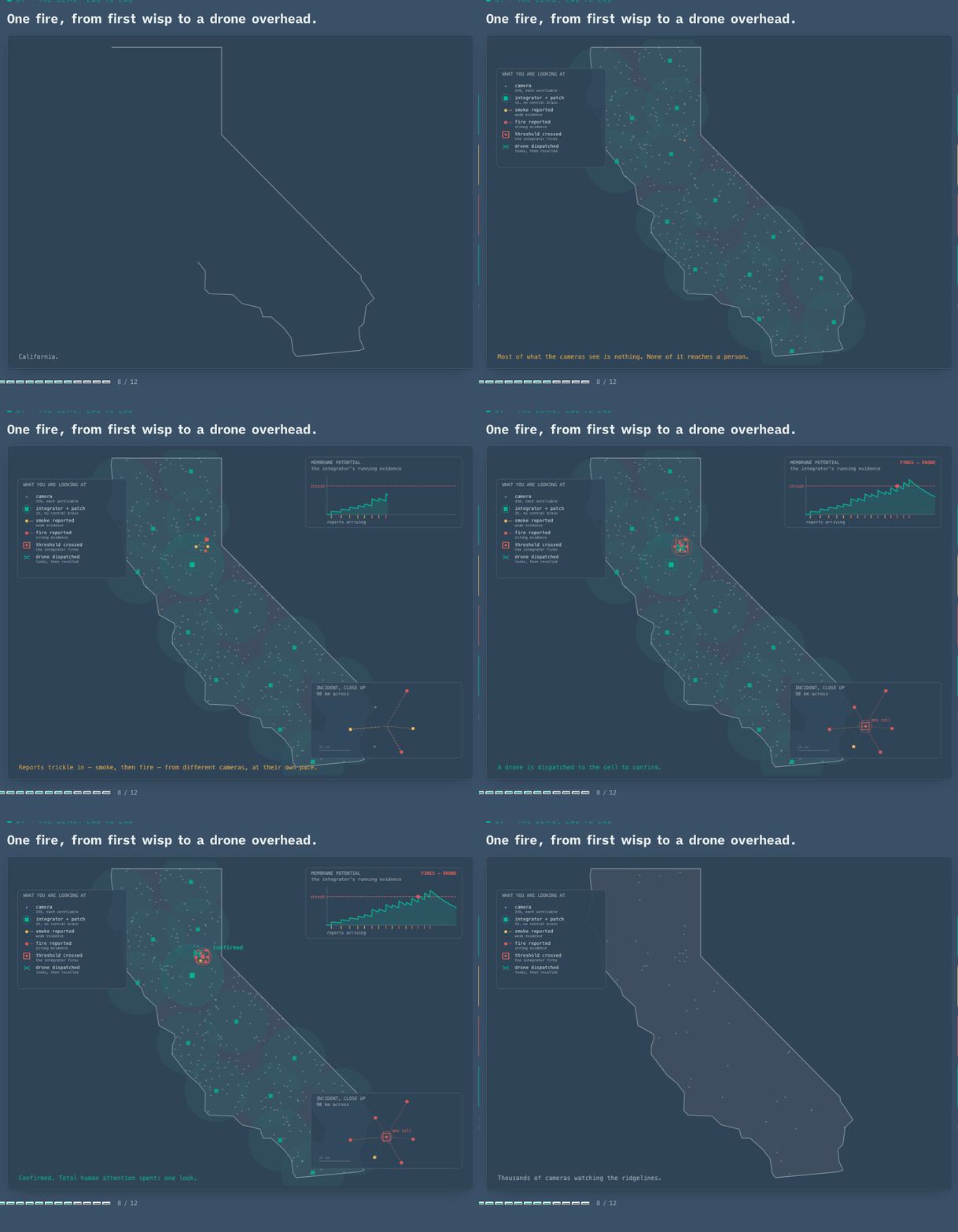
An integrator that weighs what the cameras report. One camera saying "something over there" is a guess. Several cameras, looking from different places and agreeing, is a location. The integrator gathers those reports and only raises an alert when they add up. It runs on a single Arduino UNO Q.
Between the two, all that travels is sixteen bytes: what was seen, how sure, which direction, and when. No image ever leaves the camera. Sixteen bytes will cross a license-free radio link; a photograph never will.
Why it has to run on the camera
The radio decides it. There is no bandwidth for video where these cameras are. Anything that needs the picture to travel cannot run here.
It is what lets a sensor take part. Nobody hands a fire service their doorbell footage. A doorbell that decides for itself and sends a yes or no can join. So can a gas sensor, a lightning feed, a satellite hotspot: all of them are sixteen bytes, all weighed the same way.
Agreement across different sensors is hard to fake. The more unlike the sources, the more an alert means something.
There is nothing to consent to. No personal or biometric data is ever collected, because no frame is ever kept or sent.
There is nothing central to attack, and no single box whose failure blinds the whole network.
Where we are
Working now. The detector is written and runs on real hardware, down to the smallest board we could find. On the same test set it stays quiet on empty scenes almost as reliably as a full-size model many times its size. The integrator is written, covered by tests, and runs end to end in simulation on the same code intended for the board.
Not yet. We do not have the UNO Q in hand, so every integration result is simulated rather than measured. Nothing has been tested on real tower footage yet, and the training images are ground-level photographs from another continent, which is the gap that worries us most. Power draw has not been measured. Every sensor we have fused so far is a camera. The confirmation drone is not built: today the output is a dispatch cue with coordinates.
What we would honestly claim. Not fewer acres burned. The published evidence on whether faster reporting reduces fire size is not on our side, and we are not going to pretend otherwise. What we claim is operational: fewer things a human has to look at, and fewer crews and aircraft sent on a maybe. That matters on its own, because about twenty wildland firefighters are killed every year and nearly half of those deaths are in vehicles and aircraft. The danger is concentrated in being sent.
Built in the open
Both repositories are public, with their licences declared from the first commit.
We publish build notes as we go rather than one report at the end, including the parts that went wrong. The first long write-up on the tiny detector is already up at kernwerk.org, boot loops and false alarms included.
Camera frames: HPWREN, UC San Diego, and the D-Fire dataset.