Supported by EDGE AI FOUNDATION · Part of the Internet of Communities™
advanced
ExploreProjectsEmberSentry-Edge

EmberSentry-Edge

Ultra-Early Off-Grid Wildfire & Ember Acoustic-Visual Detection Node

m_w
m_w
Published Aug 31, 2026
advancededgeai
EmberSentry-Edge

Project Proposal: EmberSentry-Edge

Ultra-Early Off-Grid Wildfire & Ember Acoustic-Visual Detection Node

  • Contest: The Resilient America Preparedness Challenge
  • Track: Track A — Developers
  • Primary Focus Areas: Anticipate and Mitigate Risk / Operate in Mission-Critical Environments
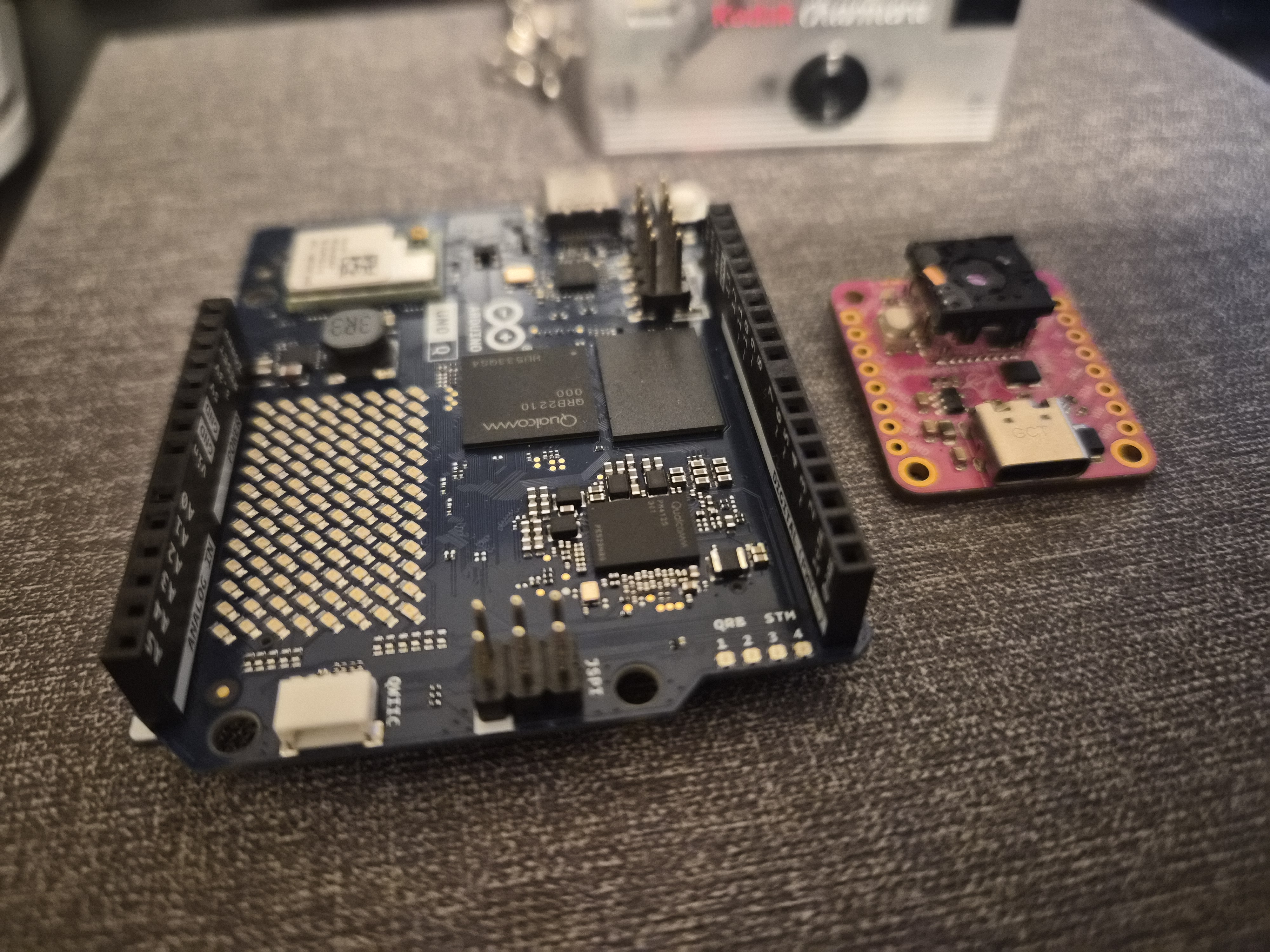
  • Core Tech Stack: Arduino® UNO™ Q (Qualcomm® Dragonwing™ Platform + STM32U585 MCU), Edge Impulse, FLIR Lepton 3.5, LoRa SX1262 Mesh

1. Executive Summary & Problem Statement

Wildfires present a rapidly escalating crisis to infrastructure and human life, yet existing early warning systems remain fundamentally flawed. Satellite thermal passes can take hours to update, while traditional visual cameras are blinded by night conditions, dense forest canopies, and dust clouds. Crucially, when wildland fires break out, power grids and cellular infrastructure are often destroyed first, creating catastrophic communication blackouts.

EmberSentry-Edge is a self-contained, solar-powered multi-modal edge intelligence node engineered for deployment along high-risk wilderness-urban interfaces (WUI). Powered by the Arduino® UNO™ Q dual-processor platform and optimized via Edge Impulse, EmberSentry-Edge detects wildfires in the pre-ignition/pyrolysis stage (before visible flame or massive smoke plumes emerge) using an array of environmental, acoustic, and radiometric thermal sensors. Operating with zero dependence on cloud connectivity, cellular networks, or grid power, EmberSentry-Edge forms an autonomous, self-healing off-grid LoRa mesh to route instant threat vectors directly to first responders.


2. System Architecture & Multi-Modal Edge AI

The core architectural innovation of EmberSentry-Edge relies on the Arduino UNO Q’s dual-brain capability to execute a multi-layered, duty-cycled AI pipeline.


Layer 1: Continuous Anomaly Detection (STM32U585 MCU)

  • Execution Environment: Bare-metal / Zephyr OS on the low-power STM32 MCU.
  • Hardware Core: Driven by the low-power MCU domain of the Arduino UNO Q platform.
  • Sensor Suite: Sensirion SEN55 / Bosch BME688 (VOCs, CO, Particulate Matter PM2.5/10) + BME280 (Temperature, Humidity, Barometric Pressure).
  • Edge Impulse Model: 1D-Convolutional Neural Network (Conv1D) running continuous time-series anomaly detection.
  • Function: Continuously monitors the local atmosphere for chemical pyrolysis signatures (gas spikes emitted as wood heat decays prior to combustion). When an anomaly score breaches set thresholds, it asserts a hardware GPIO line to wake the Qualcomm MPU.

Layer 2: Multi-Modal Verification Cluster (Qualcomm Dragonwing MPU)

  • Execution Environment: Debian Linux on the high-performance Qualcomm Dragonwing QRB2210.
  • Sensor Suite: FLIR Lepton 3.5 Radiometric LWIR thermal camera (160×120), OV5640 5MP optical camera (MIPI-CSI), and Knowles SPH0645LM4H digital MEMS microphone.
  • Edge Impulse Models:
  1. Thermal/Visual Model: Edge Impulse FOMO (Faster Objects, More Objects) trained on radiometric heat gradients and smoke patterns to locate heat centroids and hot spots (>150°C) through dense canopy or total darkness.
  2. Acoustic Model: MFE (Mel-Filterbank Energy) audio classifier trained to recognize the acoustic frequencies of dry timber cracking and canopy fire noise.
  • Function: Validates the event with high confidence, preventing false alarms, and constructs a signed emergency payload containing geo-location, temperature delta, and wind vectors.

3. Hardware Inter-Process Communication (IPC)

The system utilizes a high-efficiency hybrid UART + GPIO Hardware Interrupt scheme to connect the two onboard processing domains:

+-------------------------------------------------------------------------------+
|                           EMBERSENTRY-EDGE IPC ARCHITECTURE                   |
|                                                                               |
|  +-------------------------+                     +-------------------------+  |
|  |     STM32U585 MCU       |                     | Qualcomm Dragonwing MPU |  |
|  |   (Runs Zephyr OS)      |                     |    (Runs Debian Linux)  |  |
|  |                         |                     |                         |  |
|  |  [Active 24/7 Sensor]   |--- GPIO Wake Line ->|  [Power-Management PMIC]|  |
|  |                         |    (Hardware Edge)  |                         |  |
|  |                         |                     |                         |  |
|  |  [Arduino Bridge RPC]   |<=== UART Bus ======>|  [Python/C++ Daemon]    |  |
|  |                         | (Telemetry Payload) |  (/dev/ttyHS1 @ 921k)   |  |
|  +-------------------------+                     +-------------------------+  |
+-------------------------------------------------------------------------------+
  • Wake Signaling: The STM32 MCU drives a dedicated physical GPIO line HIGH to trigger the Qualcomm PMIC when an atmospheric pyrolysis event is detected.
  • Data Transport: Telemetry payloads (sensor metrics and trigger states) transfer across the internal UART bus running at 921,600 baud using the Arduino Bridge / RPC Protocol wrapped in MessagePack.

4. Off-Grid Communication & Network Architecture

EmberSentry-Edge provides two-tier off-grid connectivity via an onboard Semtech SX1262 LoRa transceiver:

  1. Local Node-to-Node Mesh (RadioHead on STM32): Low-overhead, raw packet transmission carrying binary sensor payloads between neighbor nodes.
  2. Long-Haul Gateway Relay (Reticulum Network Stack on Qualcomm MPU): Cryptographically signed, dynamic mesh routing running via Python on Linux to route critical alerts and thermal metadata across long distances to the Incident Command Post (ICP).

5. Power Subsystem & Energy Budget

To guarantee operational autonomy through cloud cover and heavy smoke haze, the system utilizes a 12.8V 6.0Ah (76.8 Wh) LiFePO4 battery paired with a 10W monocrystalline solar panel managed by a CN3791 MPPT Solar Charger.

Operational StateActive HardwarePower DrawDuty Cycle
State 0: Deep SleepSTM32 RTC Timer0.05 mW95%
State 1: L1 SensingSTM32 MCU + Gas + LoRa Rx14 mWPeriodic (1s / 30s)
State 2: L2 VerificationQualcomm MPU + FLIR Lepton 3.5 (150mW) + Cam + Mic2.65 WEvent Triggered (60s)
State 3: Alert TransmissionQualcomm MPU + LoRa Tx (+22 dBm)4.25 WEvent Triggered (<5s)

Energy Calculations

Daily Energy Consumption:

  • Baseline Sensing: 24 hours × 0.014 Watts = 0.336 Wh / day
  • Layer 2 Verification (10 events/day including FLIR Lepton active draw + shutter FFC burst): 10 × 60 seconds × 2.65 Watts = 0.442 Wh / day
  • LoRa Alerts (10 transmissions/day): 10 × 5 seconds × 4.25 Watts = 0.059 Wh / day
  • Total Daily Energy Requirement: ~1.12 Wh / day (accounting for power conversion efficiency)

Autonomy Reserve (Zero Solar Input):

  • Battery Capacity: 76.8 Wh (12.8V @ 6.0Ah)
  • Maximum No-Sun Operational Window: 76.8 Wh ÷ 1.12 Wh/day = 68.5 Days

6. Full Lifecycle Application: Containment & Recovery

EmberSentry-Edge remains operational across all phases of a wildfire event:

  • Mitigation (Pre-Ignition): Detects early pyrolysis gas emissions and timber stress prior to flame production.
  • Containment (Active Fire): FLIR Lepton thermal imaging penetrates smoke plumes to spot embers crossing firebreaks and calculate real-time Rate-of-Spread (RoS) vectors.
  • Recovery (Mop-Up Phase): Identifies subterranean root fires and sub-surface hot spots (>150°C) beneath cool top-ash to prevent reignition.

7. Bill of Materials (BOM) & Cost Breakdown

The Bill of Materials balances high-performance multi-modal sensing with commercial viability for field deployment at scale. Component documentation and technical specification links are included below.

CategoryComponent DescriptionSpecific Part / ModulePrototype Cost (1 Unit)Volume Cost (1,000 Units)
Compute & ProcessingDual-brain Development BoardArduino® UNO™ Q (Qualcomm Dragonwing + STM32U585)$55.00$38.00
Thermal Sensing160×120 LWIR Radiometric Thermal CoreFLIR Lepton 3.5 Core + PureThermal Breakout$240.00$165.00
Optical & Acoustic5MP MIPI Camera + MEMS Audio MicOmniVision OV5640 Camera + Knowles SPH0645 LM4H$18.00$9.50
Environmental GasMulti-gas (VOC/CO/PM) & MicroclimateSensirion SEN55 + Bosch BME688$38.00$22.00
Off-Grid Radio915MHz +22dBm LoRa TransceiverSemtech SX1262 Module (e.g., Ebyte E22-900T22S)$12.00$5.80
Power & Storage12.8V 6.0Ah LiFePO4 Battery PackMiady 12V 6Ah Deep Cycle LiFePO4 Pack$32.00$19.00
Solar Generation10W 18V Monocrystalline ETFE Panel10W Panel + CN3791 MPPT Solar Charger Board$28.00$14.50
Enclosure & HardwareIP67 Weatherproof Casing & MountsCustom 3D Printed / Molded Case + Gaskets + Brackets$25.00$11.00
MiscellaneousConnectors, Antennas, PCBs, HardwareWaterproof SMA Antenna + Qwiic Cabling + Passive components$15.00$6.20
TOTALPer-Node Unit Cost$463.00$291.00

8. Compliance with Track A Judging Criteria

  • Innovation (35%): Multi-modal fusion of gas, acoustics, optical, and radiometric thermal data on a duty-cycled dual-brain architecture.
  • Prototype Functionality (30%): Complete integration of Arduino UNO Q hardware, Edge Impulse ML models, and off-grid LoRa mesh protocols.
  • Resilience Impact (25%): Ultra-early detection combined with complete off-grid autonomy during infrastructure destruction.
  • Team Potential (10%): Leverages established open-source hardware standards (Bosch, Sensirion, FLIR) and software stacks (Zephyr OS, Reticulum, Edge Impulse).