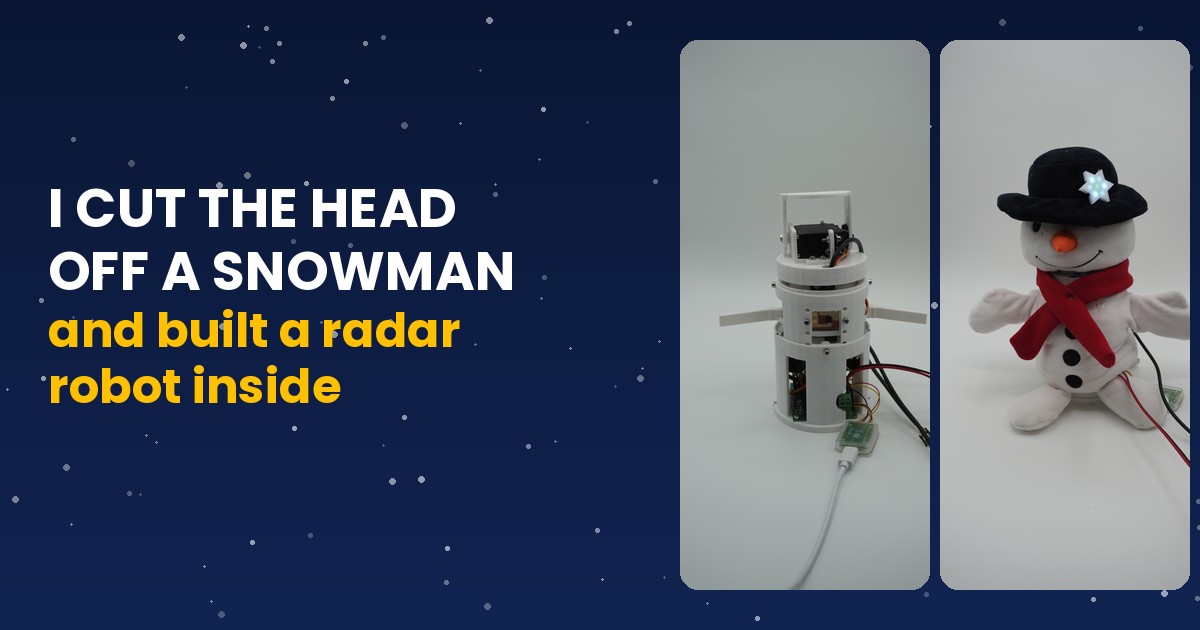
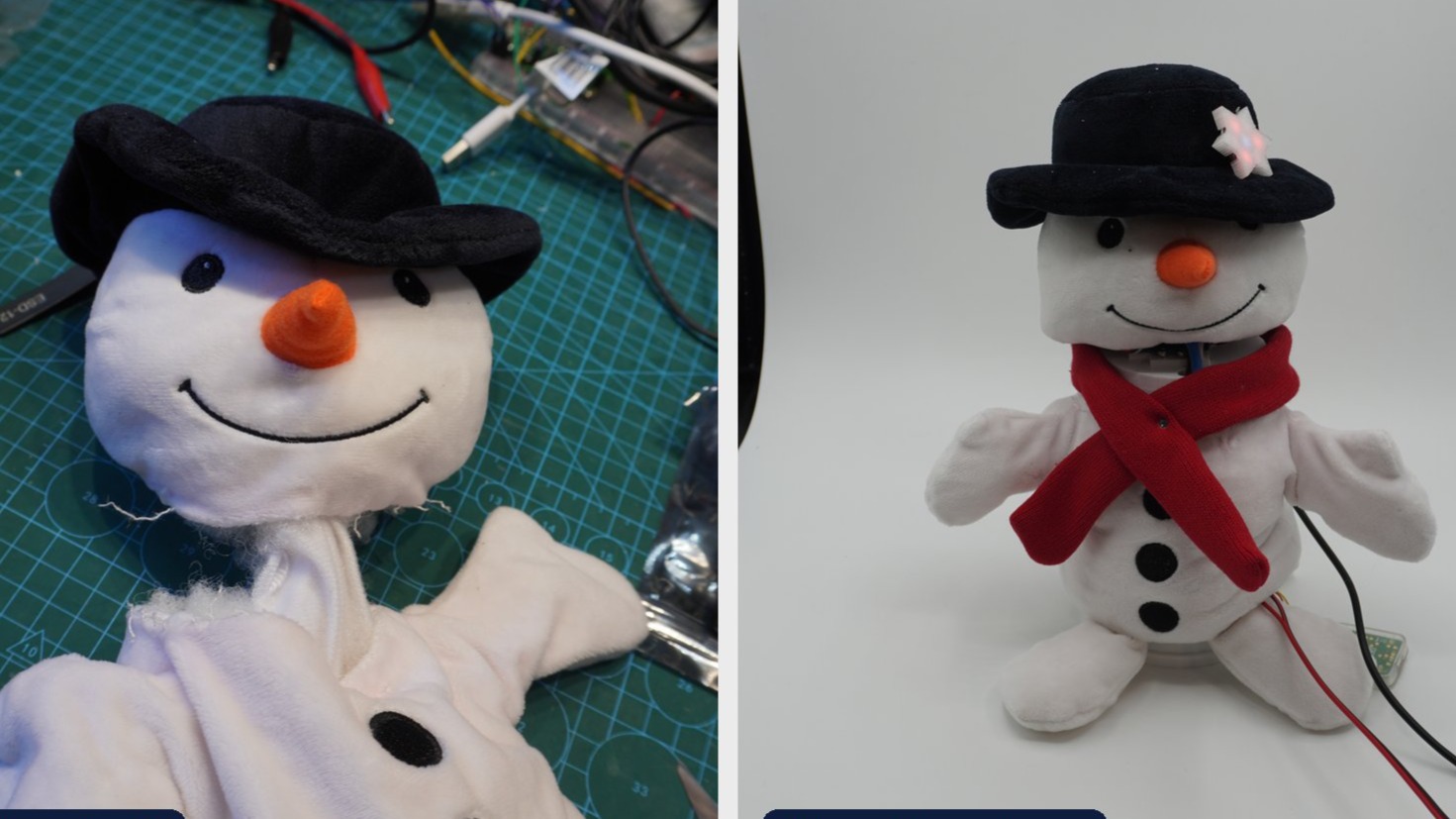
I cut the head off a snowman glove puppet and built a robot inside it. He sleeps until someone walks in, then wakes up, turns to look at you and waves. Stand and chat and he nods along. Step closer than a metre and the star on his hat turns red and he shakes his head. No camera: a 24 GHz radar sees straight through his fur. A Raspberry Pi Pico 2 W drives four servos, the radar and a 7 LED star, and a small hierarchical state machine gives him a personality.
This is the sequel to my Halloween radar skull, which taught me servo easing, radar presence detection and a simple state engine. The question for the snowman was whether those tricks scale: twice the servos, a soft body instead of a hard shell, a skeleton designed from scratch, and a character that has to feel friendly rather than predatory.
A glove puppet is made for a hand, and a hand moves everything from below. Servos need something solid to push against, and I wanted the head to pan and tilt on its own and each arm to move by itself. So the head came off at the neck. It became a cap on a pan and tilt plate, lined with an old white sock so it has enough stretch to turn and tilt. The body became a sleeve that slides over the skeleton, with the puppet's arms over bent rods that swing forwards like a hug
The skeleton is a stack of 3D printed cylinder sections designed in Blender: the control board at the bottom, the arm servos in the middle and the pan and tilt on top, about 13 cm up. The radar sits behind a window at the front, and sees straight through the plastic and the fur.
My servo library allowed one servo per PWM slice, and the board's headers sit on just three slices. Both channels of a slice share one counter, and every hobby servo wants 50 Hz, so two servos can share a slice. I forked the library: a servo table indexed by slice and channel, a shared wrap interrupt that steps both servos, and a critical section around starting and finishing a move. That's up to 16 servos on an RP2350A.
Above that sit a small kinematic framework built on Eigen, so the code can say "look at that person" rather than "pan servo to 112 degrees", and a polled animation class for waves, hugs, nods, head shakes and a dance.
A hierarchical state machine in about 300 lines of plain C++: Asleep, and Awake containing Waking up, Idle, Looking, Greeting, Entertaining, and Attending with its own Nod, Wave, Shake and Pause. Events nobody handles bubble up to the parent, so "go to sleep" is one transition that works from anywhere.
Almost every decision comes from radar distance:
A still person gets a slow two-second turn with sine easing; someone walking past gets quick 50 ms moves with exponential easing.


 milocharmingmagician
