ExploreProjectsResilience Deck (like a Cyber Deck for emergencies)
Resilience Deck (like a Cyber Deck for emergencies)
Resilience Deck is an open-source, offline-first field computer designed to help communities diagnose, understand, and restore critical systems when normal infrastructure is unavailable.
When a disaster takes down power, communications, and internet access, communities lose more than connectivity. They also lose the technical knowledge, diagnostic tools, and expertise needed to restore the systems they depend on. The manual for the pump is on a website nobody can reach. The specialist who understands the generator is three counties away.
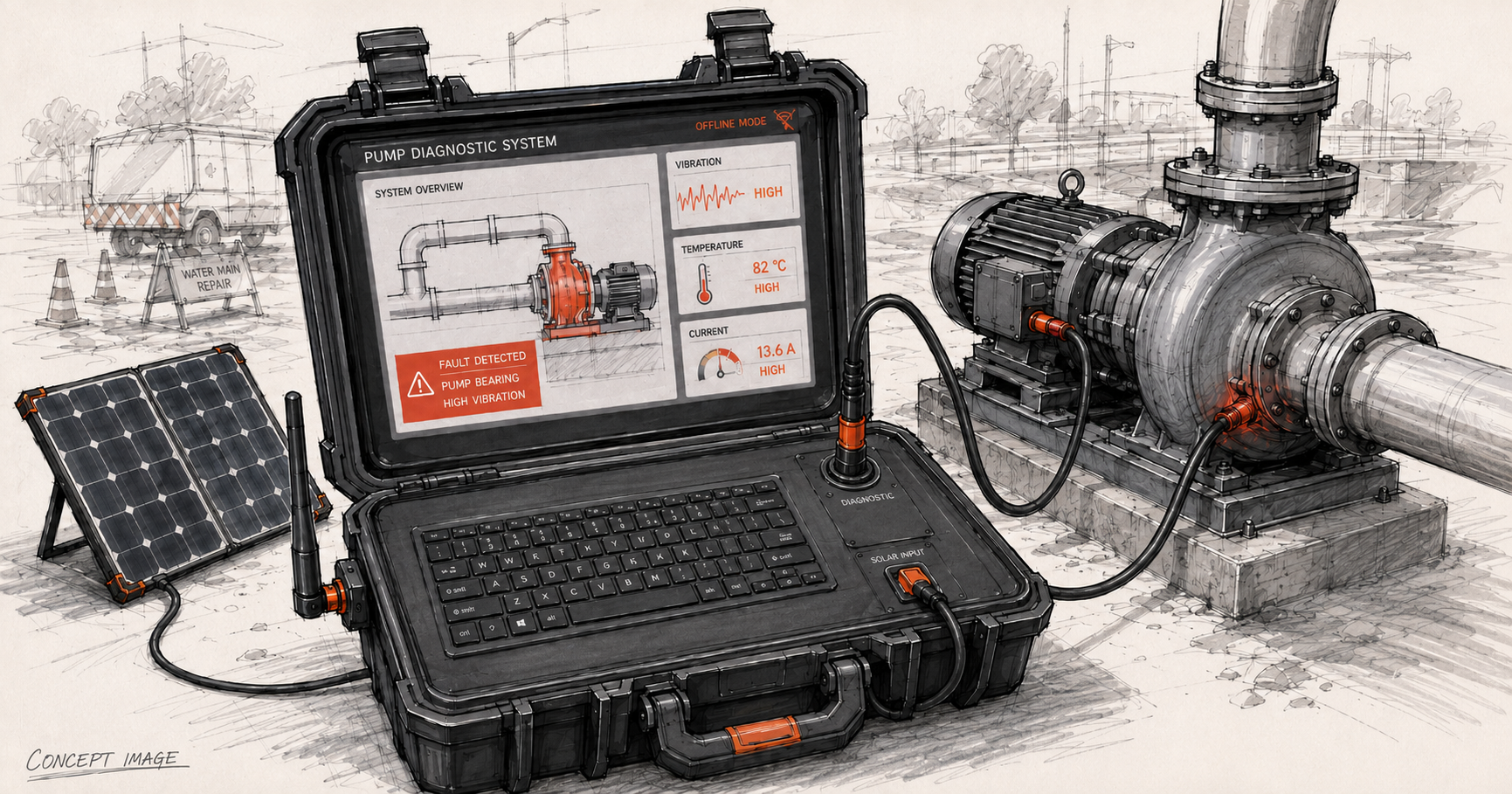
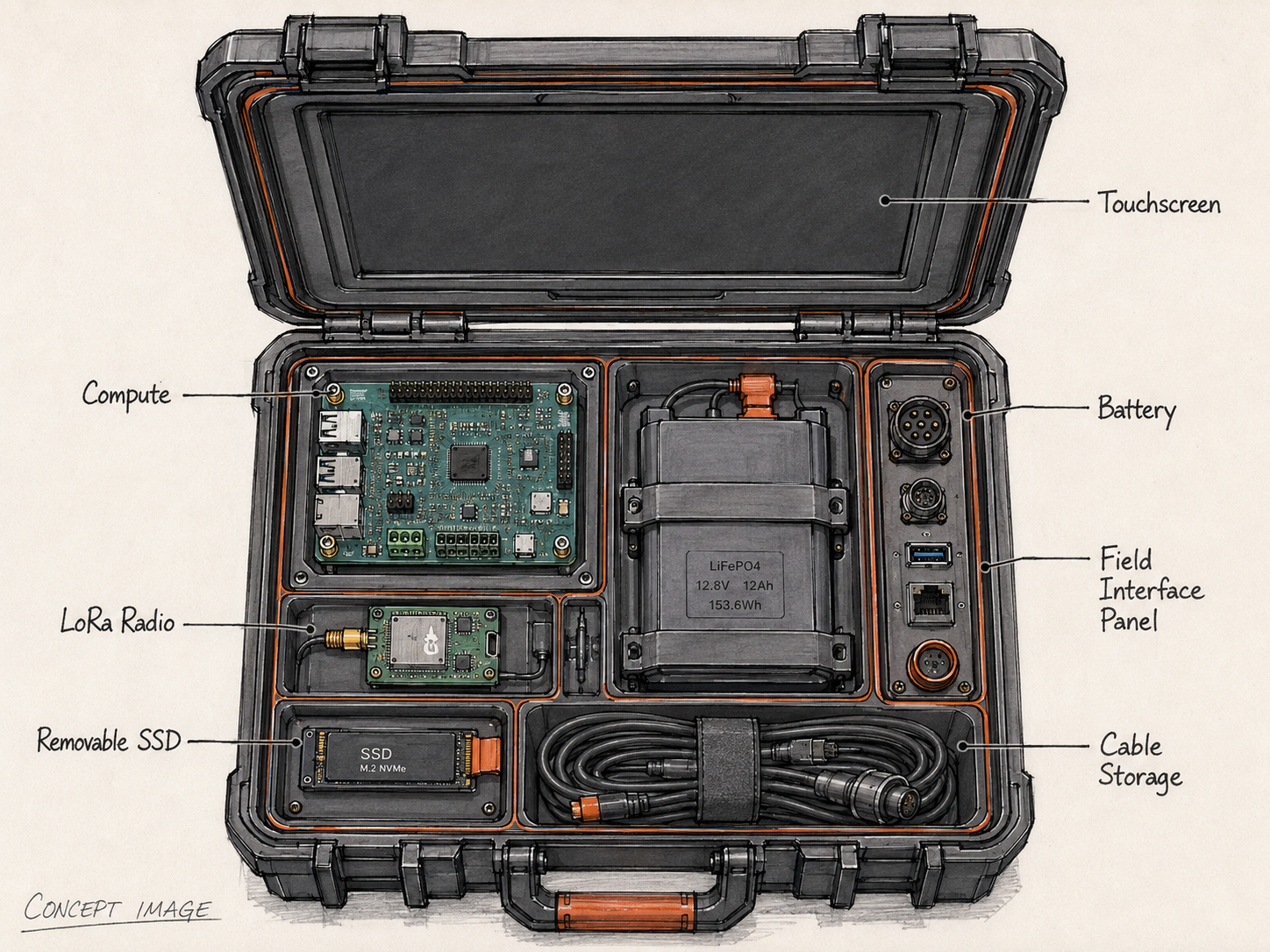
Resilience Deck is a rugged, open-source, offline-first edge AI field computer that keeps that capability local. Built around the Arduino UNO Q in a Pelican-style case, it combines on-device AI developed with Edge Impulse, a small local language model, machine-readable hardware knowledge (OpenUHD), an offline technical library, Meshtastic mesh communications, and a modular interface for external sensors and diagnostic tools. It is deliberately not a suitcase full of instruments. It is the portable intelligence layer that connects to whatever tools fit the job and helps a responder work out what the system is, what is wrong, and what to do next.
The core principle: critical technical knowledge should not disappear when connectivity does.
This is a Stage One proposal (Startup track). Nothing here has been built yet. If selected, this page becomes the public build log.
The Problem and Who It Serves
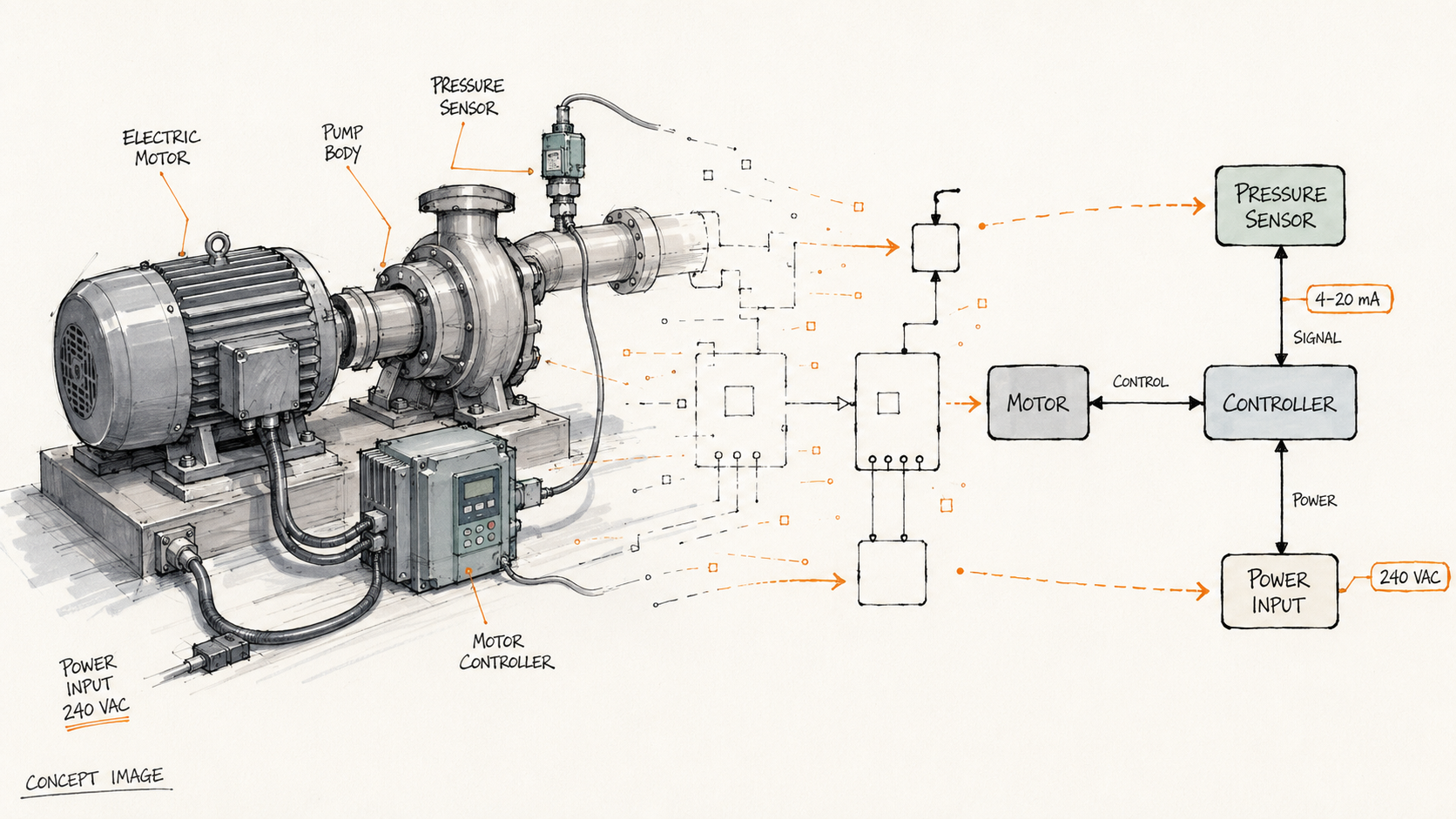
A water pump is mechanically simple, but diagnosing the complete system means understanding the motor, electrical supply, controller, sensors, firmware, and protocols, and that information is fragmented across manufacturer websites, manuals, cloud platforms, and the memory of specialists. In normal times that is an inconvenience. During a disaster it stalls recovery: a working spare part with no way to confirm compatibility, measurements with nobody to interpret them, a public works crew beside a misbehaving pump with no internet and no documentation.
Resilience Deck is built for the people working in those degraded conditions: emergency-management and public works teams, water and electrical utilities, fire and rescue, rural communities and shelters, humanitarian organizations, and technically capable volunteers. It addresses three Challenge pillars directly: Enable Real-Time Response, Accelerate Recovery and Continuity, and Operate in Mission-Critical Environments.
Technical Approach
The Arduino UNO Q's dual architecture fits a field computer unusually well. The Qualcomm Dragonwing QRB2210 runs Debian Linux and handles the interface, local databases, AI inference, and networking, while the STM32U585 handles real-time sensor acquisition and hardware interfacing. We will use the 4 GB configuration. The Deck also stays a real Linux machine: an operator can open a terminal, flash firmware, or install new tools in the field, so the system does not become useless the moment reality departs from our assumptions.
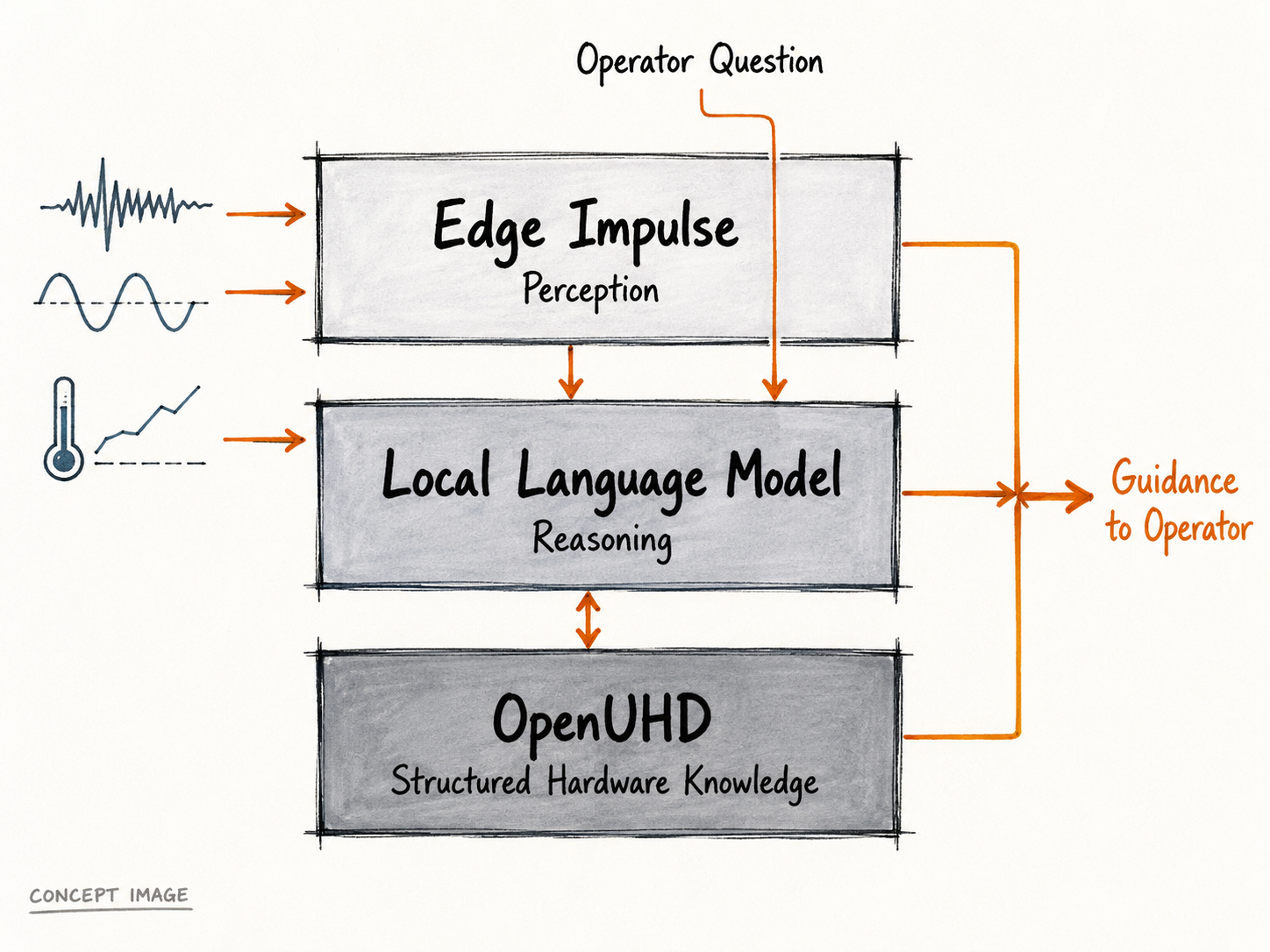
The AI is layered rather than one general-purpose model.
Layer 1: Edge Impulse perception. A custom model developed with Edge Impulse and deployed to the UNO Q. For the prototype we will instrument a small pump with vibration, current, temperature, and acoustic sensing, train on normal operation plus reproducible fault conditions, and run anomaly detection and condition classification entirely on-device.
Layer 2: A small local language model. The human-facing interface. It does not memorize every machine ever manufactured. It interprets the operator's question, pulls in the live Edge Impulse inference, retrieves the relevant slice of local documentation and system structure, and walks the operator through the next useful step.
Layer 3: OpenUHD, structured hardware knowledge. Instead of dumping PDFs onto an SSD, the Deck carries machine-readable system descriptions using OpenUHD, the open-source Universal Hardware Description standard we develop at Delta Robotics: components, interfaces, requirements, and linked artifacts such as firmware, schematics, and manuals. That turns the problem from "make a tiny AI know everything" into "give a tiny AI exactly the right information." Our design platform, Protoboard, authors and validates these definitions during development; the Deck carries them into the field, so a hardware definition stays useful for the life of the machine: design, build, deploy, operate, diagnose, repair.
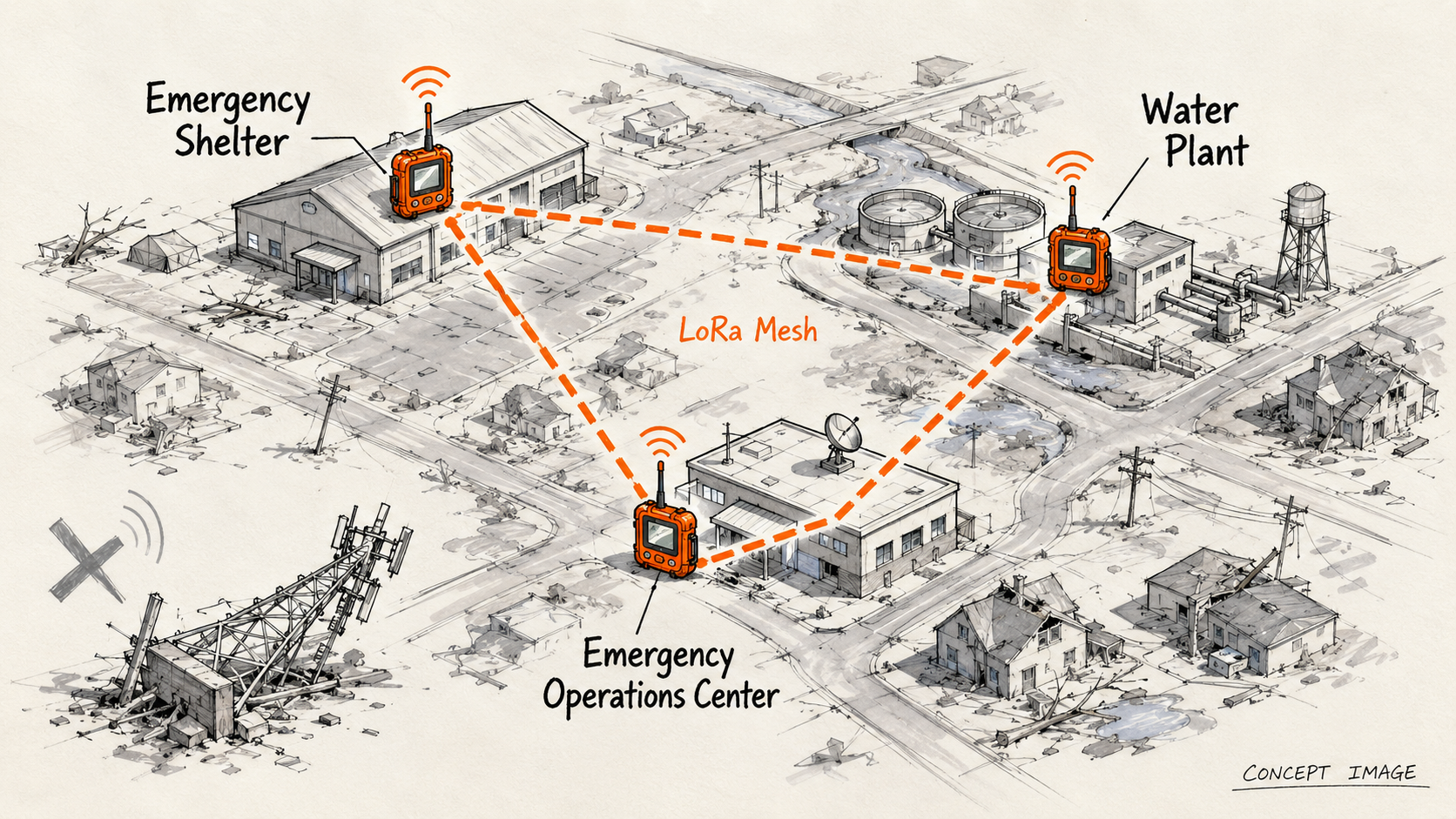
Around that core: a modular field interface (USB, Ethernet, UART, CAN, RS-485, I2C, GPIO) connects the specialized instruments responders already own, so the Deck interprets rather than duplicates every tool. Removable storage carries the offline library (references, manuals, maps, firmware, OpenUHD packages) and can be swapped per organization. A Meshtastic LoRa node gives each Deck infrastructure-independent text and status, and several Decks in range automatically form a local network. Power is battery-first with solar, USB-C PD, and DC input, and the major subsystems are field-replaceable modules.
A Deployment, Step by Step
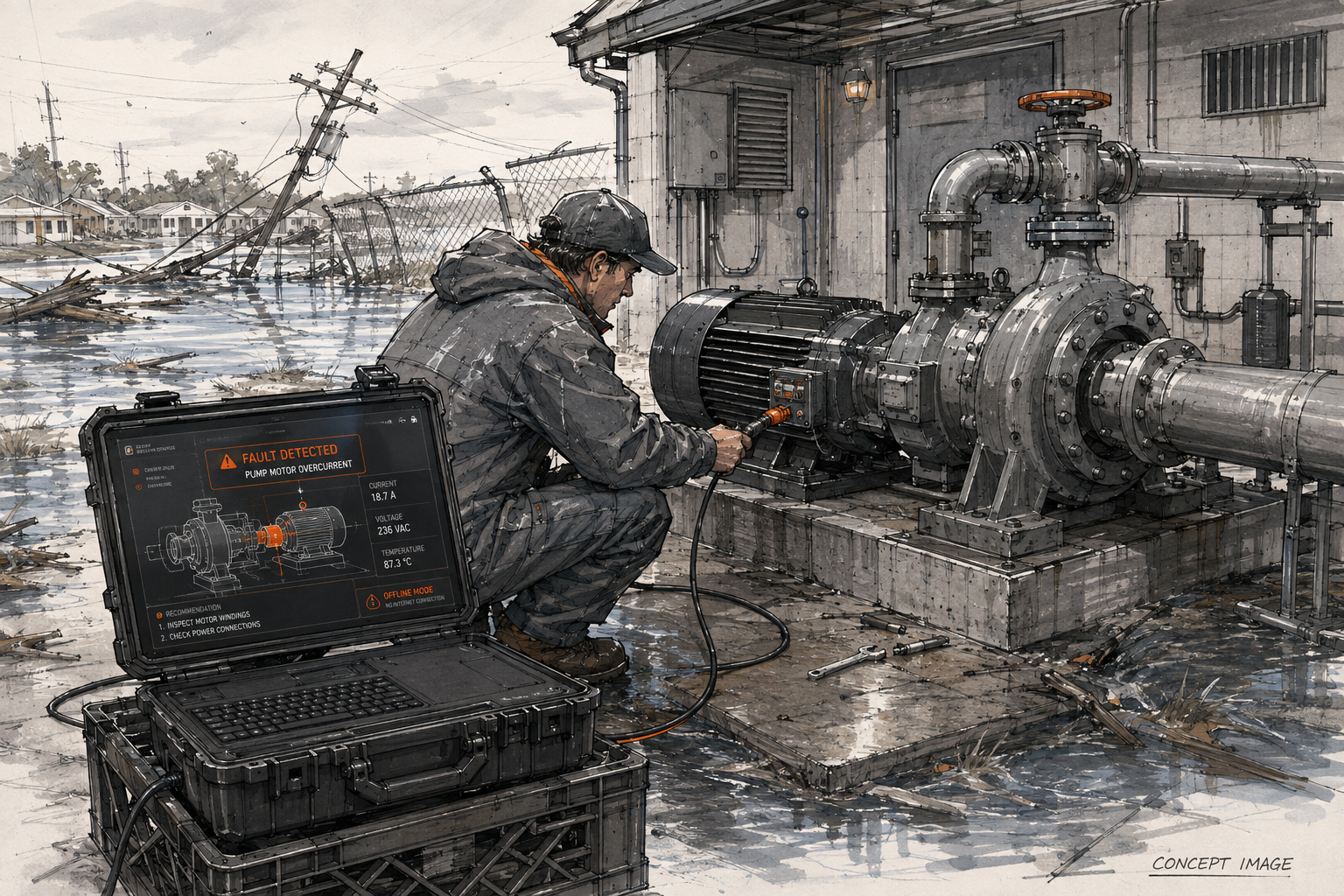
A hurricane has taken down municipal infrastructure and internet access. A public works team reaches a pumping station where one pump runs but produces almost no pressure.
The Deck starts from battery. No connectivity, no cloud.
A technician clips a vibration and current module onto the pump through the field interface.
The Edge Impulse model flags abnormal vibration and elevated current within seconds.
The technician asks: "Why is this pump drawing high current but producing low pressure?"
The local model combines the live inference, the pump's OpenUHD description, and stored service documentation, then walks through the tests that separate an electrical fault from a mechanical or hydraulic one.
A replacement sensor is on the truck. The OpenUHD model confirms compatibility and shows the pin mapping.
The result reaches a second Deck at the emergency operations center over Meshtastic.
Every step happens locally. That is the demonstration we intend to build.
Why This Must Run at the Edge
The Deck exists for exactly the situations where cloud dependence fails: downed towers, dark ISPs, degraded power, unreachable specialists. Inference, the assistant, OpenUHD navigation, documentation search, diagnostics, and mesh communications all run on-device. Connectivity is an optional sync mechanism: when it exists, the Deck updates models, maps, and libraries. When it disappears, nothing stops working.
Estimated Prototype Hardware
Estimates, not a finalized bill of materials.
Rough total: $1,000 to $1,400.
Scope and Feasibility
The prototype will demonstrate eight things:
A rugged, battery-powered UNO Q running as a usable Linux field workstation.
A custom Edge Impulse model trained on real sensor data, inferring on-device.
An external diagnostic module connected to an instrumented pump through the field interface.
A local language model combining operator questions with Edge Impulse results and structured system knowledge.
An OpenUHD definition of the demonstration system with linked documentation.
The complete diagnostic workflow with internet physically disconnected.
Meshtastic communication with a second node.
Battery operation with solar charging.
We design and validate the system architecture in Protoboard before assembly, and nearly every component is off-the-shelf, so we expect the physical build to take two to three weeks. That leaves most of the sprint window for dataset collection, Edge Impulse model training, integration, and documentation.
The honest risks: the QRB2210 with 4 GB of shared RAM runs a small quantized model, not a frontier one; the retrieval-first design is the mitigation, and if the assistant underperforms, the system degrades gracefully to a deterministic OpenUHD browser plus Edge Impulse alerts, which is still a useful field tool. And scope discipline: the eight items above are the whole prototype. Everything under "Beyond the Initial Build" is explicitly out.
Sharing the Journey
The build happens in the open on this page, failures included, with everything in a public GitHub repository: enclosure CAD, wiring diagrams, source code, the Edge Impulse project and dataset methodology, the OpenUHD definitions, and a final assembly writeup, so another team can adapt the architecture to their own community's equipment.
Open Source and the Product Path
The reference design stays open. Communities, makers, and researchers should be able to build, modify, and extend their own Decks without buying anything from us. Delta Robotics plans to develop the platform commercially as assembled, tested, and supported systems for organizations that need ready-to-deploy units: utilities, municipalities, emergency-management and public works agencies, and humanitarian responders. Build it yourself if you want. Buy it ready to deploy if you need it.
Beyond the Initial Build
None of these are promised for the sprint. They are where the platform goes next.
Industry recovery kits: the Deck bundled with interfaces and knowledge packs for water systems, microgrids, flood response, or wildfire monitoring.
Mesh capability discovery and distributed knowledge: Decks advertising their interfaces and knowledge packs over the mesh, and exchanging definitions, repair notes, and maps while fully offline.
Community infrastructure graphs: towns maintaining machine-readable descriptions of their own critical systems, pre-positioned on the Decks that would respond to them.
The Longer View
Resilience planning today quietly assumes the internet will be reachable. Resilience Deck pre-positions the computing, the communications, the documentation, and a machine-readable understanding of infrastructure inside the communities that may need them.
Sense what the machine is doing. Understand what the machine is. Retrieve what humans know about it. Help the person standing next to it decide what to do.